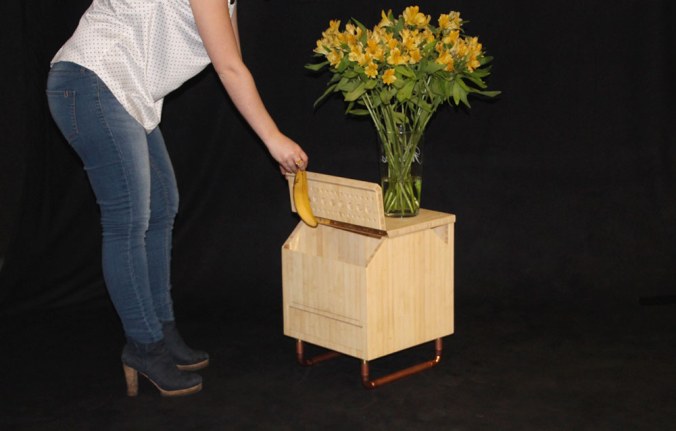
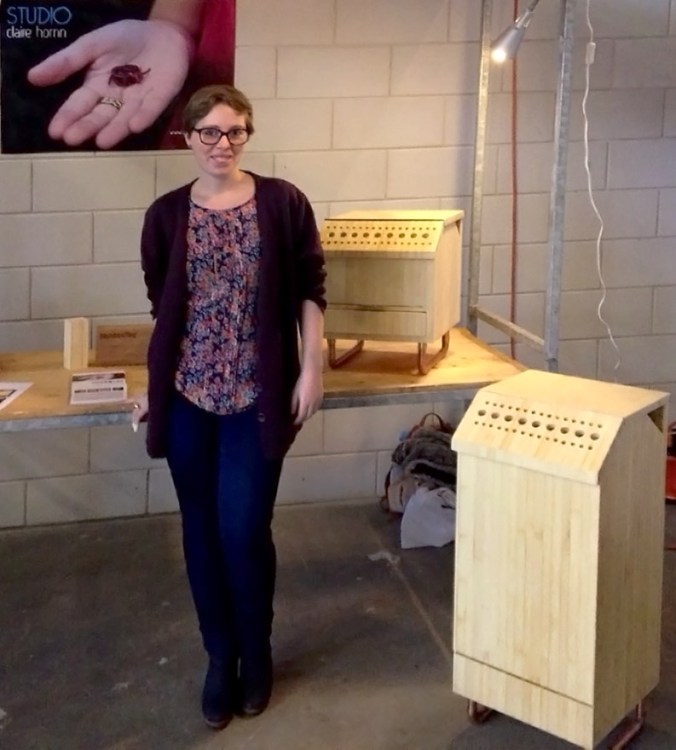
 Living and working in style – with composting worms. Dutch designer Claire Hornn has just concluded a four-month-long pilot project where her hand-made, bamboo worm bins were placed in six companies in Amsterdam for evaluation. The results were very positive and helpful towards her current designs.
  She discovered in her pilot program that users were asking for outdoor versions, but she points out that the composting process is more efficient at indoor temperatures. Claire describes her design motivations this way: “Vermicomposting is a great way to be more aware of your food waste and to green your home. It’s odourless and ideal for inside use. But where are the good-looking, functional designs for indoor composting? This question was the start of the Urbeen. The Urbeen is an indoor, design and multifunctional vermi-compostbin. It’s made out of CO2-neutral bamboo and can be used a compost-bin, a stool or little table. It fits easily small apartment and is therefore interesting for city-people who don’t have a garden or balcony.” Her most current designs will soon be available for sale online. Stay tuned by following her website and blog.
#wormculture
Street Corner Composter

Street Corner Composter by Rowin Snijder
Can worm composting become a community activity? Carpenter/artist Rowin Snijder is testing this concept out on a street corner in Amsterdam. He has designed and built a durable, oak cabinet that looks like an elevated planter box. Inside, it hides 2 vermicomposting compartments, into which neighbors can deposit their food scraps. When one side is filled, they use the adjacent section so the worms will follow the food scraps and move into it through a bamboo lattice that connects them. The finished compost can be harvested from the first bin while the second becomes full of worms that are being fed. And the composting process continues.  Rowin says, “When a group of people take it upon themselves to take responsibility for their own trash, and work together, so much more happens than just making compost. It builds community, a connection with your surrounding, and is an inspiration for others to do so as well. The compost produced, can be used in gardens in the street or on rooftop gardens and balconies.” He has also designed a version for the balcony, which he sells in Amsterdam, but also offers the plans for free on the Le Compostier Facebook page for others who want to build it themselves. And there is a new, 2 square meter version that has space for worms and bees. The bees are invited in through a yellow-painted portal in the wood box, where they can find refuge in their own protected box inside. An intriguing cohabitation with worms, bees, plants and people on the street. I look forward to hearing more about this project as it develops. Visit the Le Compostier blog for more information.

The yellow painted hole invites bees in to share the space with the worms.
The Worms Music
First album available now on Bandcamp
The Worms are a rock band sensation. Living worms are the musicians and superstars, captivating their audiences with their authentic movements through their compost medium. These multi-talented beings turn food waste into fertilizer while living inside instruments that amplify their actions, which is translated into music for human ears through technology and artistry.
The Worms’ producers, tour managers and technicians are:
Amy Youngs (Columbus OH, USA), Krzysztof Topolski (Gdańsk, PL)
Visit The Worms on Facebook.
Worm Cozies
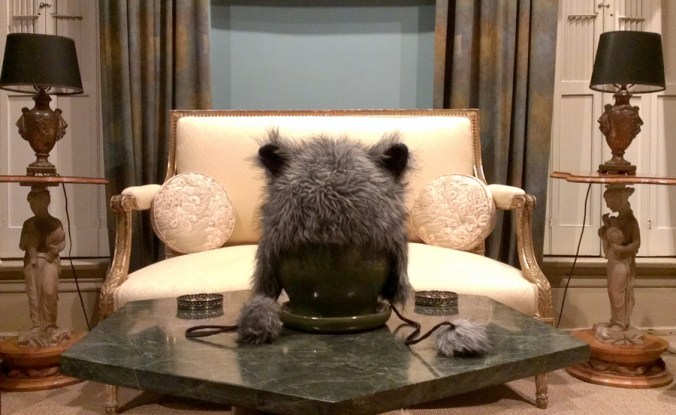 Worm Cozies are designed to help humans feel more comfortable hosting worms in their homes. Based on the concept of appliance cozies, which were originally created as a way to hide the sight of garish machines inside the domestic space of the kitchen, these worm cozies similarly function as a softening interface that will help us get used to the idea of living with worm ecosystems.
Teddy Bear Worm Tamer
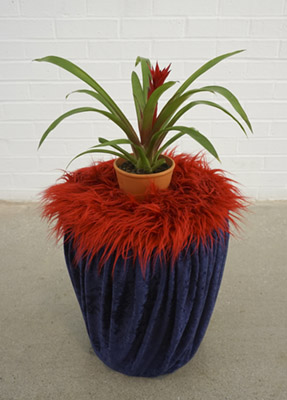
Worm Cozy Fuzzy Plant Stand
Composting worms are excellent co-habitants that can help us reduce our greenhouse gas output by eating waste paper and food scraps that would otherwise be sent to landfills, which generate methane. Local, in-home worms can transform domestic organic waste into a rich, nutritious fertilizer that can be fed to houseplants, food gardens, trees or lawns. Worm ecosystems are odor-free, silent and thrive in dark, moist places with food, so they will not want to leave their worm cozy. I understand that some people are squeamish about the idea of living with worms, which is why these cozies are designed to be friendly, fuzzy, and discrete.
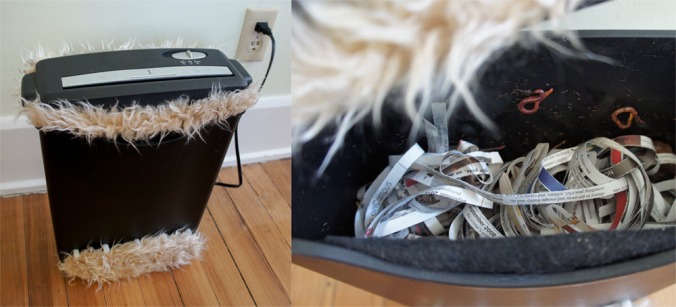
Working Paper Shredder Worm Cozy

Worm Cozy Cook Pots
These pieces are on display in the Vermiculture Makers Club Exhibition in Louisville, Kentucky.
I’ve made instructions on how to make the plant stand cozy so you can build your own.
Cascading Garden
Ken Rinaldo

Designed for urban agriculture, indoor and outdoor growing of herbs, leafy greens, house plants and ornamentals. Outdoors they are attached to rainwater barrels, collecting roof runoff and automatically watered with timers. The Cascading Growbags Vermiponic Wormbag uses live worms to convert organic compost into nutrients which are then fed back to the plants through the watering system. Using the Vermiponic Wormbag in this system allows the worms to create organic worm castings from your kitchen scraps, which then becomes worm tea in the rain-barrels. This nutrient rich water is then fed to the plants through the watering system which allows for fully organic growth of healthy food.
– more info and purchase info on Cascading Growbags site.

Breakfast with Cantaloupe
What happens when worms are engaged in the artmaking process?
By Ann Corley Silverman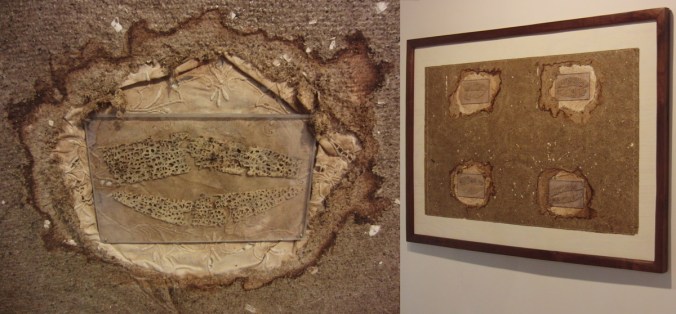
~ We could not eat a cantaloupe without the work of the decomposers who make the soil on which the melon depends. ~ The cotton placemats depend on soils for the cotton plant to grow, and laborers for planting; plucking the seed fibers; spinning the thread; weaving the fabric; and designing and making the finished cutwork placemat. Setting the table: to provide all the things for a gathering of people to eat and drink together.
Breakfast with Cantaloupe is about setting tables. The cantaloupe was for the red wriggler composting worms. They love the juicy parts of the cantaloupe. They were happy with their placemat habitat and stayed until they had eaten all but the lacey part of the rind. I wanted that part. They were my reliable collaborators. Back to the worm bin they went, and I to my meditations about tables, food, and labor.
– Ann Corley Silverman
Earthworm: drawings from observation
An exploration of external and internal anatomy, by Katherine Beigel

Ecologically indispensable, the earthworm is an intriguing organism both inside and out. With musculature and a digestive system that span its entire length, the earthworm’s activity in its environment contributes a slew of biogeochemical effects to the surrounding soils and local organisms. I took careful observations of its anatomical structures, particularly as they may relate to the worm’s physiology and behavior. Like many organisms that contribute to overall ecosystem health, the earthworm’s evolutionary lineage is intimately intertwined with its habitat. Understanding this valuable relationship allows humans to incorporate it into their own dwellings, overlapping the boundaries of modern human living with the natural world.
– Katherine Beigel
Vermiculture Furniture
A documentary by Xinge Huang about the student projects created in the Vermiculture Furniture course. A book about the class was also created.
The popular Eco-blog TreeHugger also wrote a story about the class here.
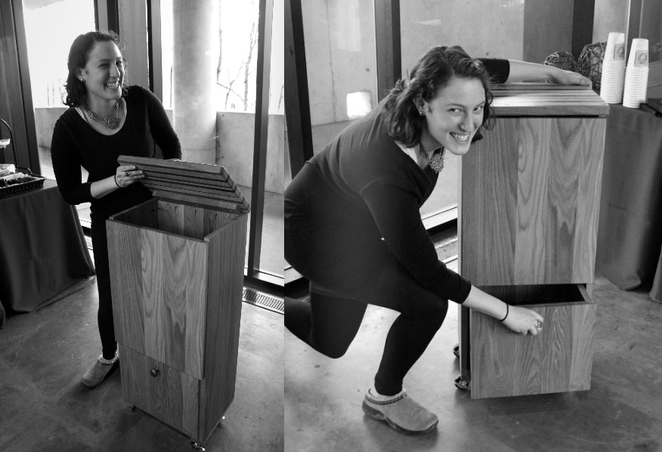
This interactive installation offers human participants an opportunity to tune into – and bodily experience – the vibrations made by tiny, soil-dwelling beings. Humans continue to be interested in detecting signals of extra-terrestrial life in outer space, but have overlooked the intra-terrestrial signals of life – the worms and insects that sustain our own terrestrial existence. This highly amplified environment allows humans a chance to appreciate these extraordinary life forms through live, amplified sounds and infrared video. Hopefully this experience will give a viewer/participant a different sense of the life inside the earth; one that goes beyond the scientific and instead approaches something more akin to fellowship, communion or appreciation.
Digestive Table
An ecosystem of worms, sowbugs, plants and bacteria live and eat at this table. They are a part of the digestive system that starts with a person discarding food leftovers and shredded paper into the portal at the top. The bacteria and sowbugs begin breaking down the waste and the worms soon join in to further digest it into a rich compost that sprinkles out of the bottom of the fabric bag that hangs beneath the table. This compost is used as a fertilizer for plants, such as those at the base of the table.
The human plays an important part at the table by eating, feeding the food waste to the worms, feeding the resulting fertilizer to the plants, or by simply sitting and appreciating the living ecosystem she/he is a part of. A cross-section of the activity inside the top 9 inches of the compost is made visible using an infrared security camera connected to an LCD screen built into the table. On the screen, viewers can see the live movements of the worms and sowbugs inside.
 Worm Culture